Summary of the Blog
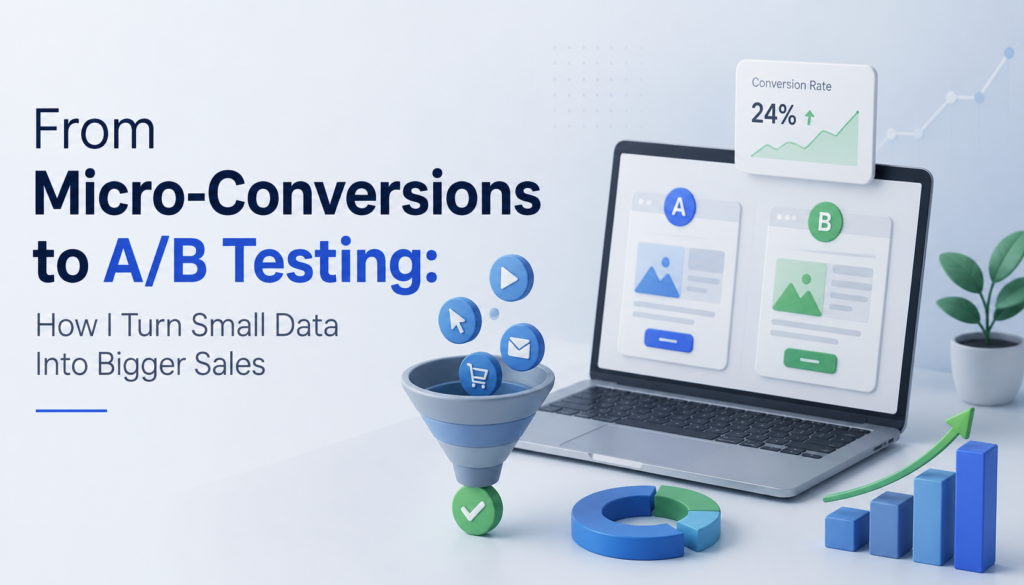
This blog covers how tracking micro-conversions and running structured A/B tests can transform campaign performance. It explains how small user actions reveal where people drop off before buying. Using both systems together helps marketers find real problems and fix them with actual evidence.
Introduction
Let me be honest with you. For a long time, I judged my campaigns by one number: the sales. Did the customer buy? Yes or no. That was it.
And I kept running into the same frustrating wall. Campaigns would go cold, and I had no idea why. I would rewrite copy, change targeting, cut budgets, sometimes things improved, sometimes they did not. I was essentially guessing. Then I changed my approach. I started tracking every small action a user takes before they buy. I started running structured A/B tests instead of random changes. And honestly? Everything shifted. I started making decisions based on real signals, not gut feelings.
This blog covers both micro-conversion tracking and A/B testing because, in my experience, they work best together. Micro-conversions tell you where users are in the journey. A/B testing tells you what moves them forward.
Part One: How I Track Micro-Conversions That Lead to Sales
What Even Is a Micro-Conversion?
A macro-conversion is your main goal: a purchase, a booked call, or a submitted lead form. A micro-conversion is every meaningful action a user takes on the way to that goal.
Think about it this way. When someone visits your site, they do not just land and immediately buy. They scroll. They read. They watch a video. They check your pricing page. They start filling out a form. Each one of those actions tells you something about their intent level.
Here are some micro-conversions I track consistently across my campaigns:
- Scroll depth: Did they read past 50% or 75% of the page?
- Time on page: Did they actually engage with the content?
- Pricing page visits are a high-intent signal, especially for SaaS and service businesses
- Video plays and percentage watched
- Add to cart (even without purchase)
- Form starts, they opened the form but did not submit
- Clicks on the phone number or email address
- The FAQ section clicks, they have specific questions, and they want answers
- Return visits within 7 days, they came back, which means they are still thinking about it
Not every micro-conversion carries the same weight. A pricing page visit from a paid ad visitor means a lot more to me than a scroll depth on a blog post. Context always matters.
Businesses that track micro-conversions see up to 30% improvement in campaign optimization accuracy. — CXL Institute
Why Micro-Conversions Changed How I Read Campaign Data
Before I tracked micro-conversions, I would look at a campaign, see zero sales, and declare it a failure. Then I would kill it.
But some of those “failed” campaigns were actually driving many pricing page visits and form starts. Users were interested, but they just needed more touchpoints before they converted. I was cutting campaigns that were actually working at the top and middle of the funnel.
Once I started seeing micro-conversion data, I stopped making those rash calls. Now I ask better questions. Are people visiting the pricing page but dropping off? That is a pricing clarity problem. Are they starting forms but not finishing? That is a friction problem in the form itself. Are they watching the video all the way through but not clicking the CTA? That is a message mismatch between the video and the offer.
Each of those problems has a different solution. Micro-conversions help me find the right problem to solve first.
How I Set Up Micro-Conversion Tracking
I use
Google Tag Manager for almost everything. It keeps my tracking clean, organized, and easy to update without having to touch the website code every time.
Here is my basic setup process:
Step 1: Define What Matters for This Specific Funnel
I sit down and map the user journey from ad click to purchase. Then I identify every meaningful stop on that journey. I do not track everything — just the actions that signal real intent or reveal real friction.
Step 2: Set Up Events in Google Tag Manager
I create custom event tags in
Google Tag Manager for each micro-conversion I want to track. Common triggers I use:
- Scroll Depth triggers — set at 50% and 75% thresholds
- Click triggers — on specific buttons like ‘View Pricing’ or ‘Watch Demo.’
- Timer triggers — to measure time on page (60 seconds, 120 seconds)
- Form interaction triggers — fires when a user clicks into a form field
- YouTube video triggers — for embedded videos, tracking 25%, 50%, 75%, and 100% played
Step 3: Send Events to Google Analytics 4
I push all these events into
Google Analytics 4 using GA4 event tags inside
Google Tag Manager. Then, in GA4, I mark the high-intent ones as key events so I can see them in conversion reports and use them for audience building.
Step 4: Import Key Micro-Conversions into Google Ads
I link
Google Analytics 4 to
Google Ads and import micro-conversions that signal real purchase intent, such as pricing page visits or video completions. I use these as secondary conversion actions in my campaigns. This gives the
Google Ads algorithm more signal to learn from, especially in the early days of a campaign when macro-conversions are sparse. Campaigns with secondary conversion actions (micro-conversions) used for smart bidding see up to 20% lower cost per acquisition. — Google Marketing Platform Blog
How I Use Micro-Conversion Data to Make Decisions
I check micro-conversion data at least twice a week. Here is what I specifically look for:
- High scroll depth + low form starts = the copy is engaging but the CTA is weak or unclear
- High pricing page visits + low macro-conversions = pricing objections or lack of trust signals on that page
- High form starts + low form completions = too many fields, confusing layout, or a technical bug
- High video plays + low CTA clicks = the video sells the concept but not the product specifically
Every pattern has a story. My job is to read that story and fix the right thing, not just change random elements and hope for the best.
Tools I Use for Micro-Conversion Tracking
- Google Tag Manager — event setup and management
- Google Analytics 4 — event reporting and audience building
- Hotjar — heatmaps and session recordings to see exactly where users drop off
- Microsoft Clarity — free session recording tool, great for seeing rage clicks and dead clicks
- Segment — for larger setups where I need to centralize event data across multiple platforms
I always run
Hotjar or
Microsoft Clarity alongside my quantitative data. Numbers tell me what is happening. Session recordings tell me why.
Part Two: My SOP for A/B Testing Ads for Faster Results
A/B testing is one of those things everyone says they do, but very few people do correctly. I have been guilty of sloppy testing myself. Running two versions of an ad for three days, seeing one perform better, and calling it a winner is not A/B testing. That is just guessing with extra steps.
Over time, I developed a real SOP for ad testing. It is not complicated. But it requires discipline. And it produces results that I can actually trust and build on.
Why Most A/B Tests Fail
Before I share my process, I want to talk about the mistakes I see most often. These are the things that killed my early tests — and that I still see in accounts I review.
- Testing too many variables at once, if you change the headline, image, and CTA at the same time, you never know what actually moved the needle
- Ending tests too early, three days of data is almost never statistically meaningful
- Testing with too little budget, low spend, means low data volume, which means unreliable results
- Picking winners based on CTR alone a high CTR ad that does not convert is not a winner
- Not documenting anything, I used to run tests and forget what I learned, which meant repeating the same experiments
Only 1 in 7 A/B tests produces a statistically significant result. The difference between winning and losing tests is almost always the testing process. — Optimizely Research
My A/B Testing SOP — Step by Step
Step 1: Start With a Hypothesis, Not a Hunch
Every test I run starts with a specific hypothesis. Not “let me try a different image” but “I think a real customer photo will outperform a stock image because our audience responds to authenticity over polished visuals.”
The hypothesis has to be based on something: data from micro-conversions, insights from session recordings, patterns from previous tests, or clear signals in audience comments and messages. A hypothesis with a reason behind it teaches you something even when the test fails. A random change teaches you nothing.
Step 2: Isolate One Variable
I test one thing at a time. Always. This is the rule I protect the most.
If I test the headline, everything else stays identical. Same image. Same body copy. Same CTA button. Same landing page. The only difference is the headline.
Yes, this means testing is slower. But the results are clean, and I actually learned something I can apply to future campaigns.
Step 3: Set Your Success Metric Before You Launch
I decide before I launch what metric determines the winner. For awareness campaigns, it is usually CPM or reach. For traffic campaigns, it is Cost Per Landing Page View or Outbound CTR. For conversion campaigns, it is always Cost Per Acquisition or Return on Ad Spend.
I never change the success metric mid-test. If I start a test measuring CPA and then switch to CTR because CPA looks bad, I just invalidated the test.
Step 4: Give the Test Enough Time and Budget
I follow two rules for test duration:
- Minimum 7 days — to account for day-of-week variation in user behavior
- Minimum 50 conversions per variant — before I consider any result meaningful
If a campaign does not have enough budget to generate 50 conversions per variant in a reasonable time frame, I use a higher-funnel micro-conversion as my success metric instead — like Cost Per Landing Page View or Cost Per Add to Cart.
Tests that run for less than 7 days have a 40% higher rate of producing false positives. — VWO Testing Research
Step 5: Use Platform-Native Testing Tools
I almost always use the built-in experiment tools rather than manually setting up A/B tests through duplicate campaigns. Here is what I use on each platform:
Using native tools removes a lot of the manual headaches. The platform handles traffic splitting, and the statistical significance calculations happen automatically.
Step 6: Let the Algorithm Stabilize Before You Read Results
Every ad campaign goes through a learning phase — especially on
Meta Ads. During this phase, performance is erratic and the data is not reliable.
Meta typically needs around 50 optimization events before it exits the learning phase.
I never read test results while the algorithm is still learning. I wait. I check that both variants have exited the learning phase before I compare numbers. It takes patience, but it saves me from making decisions based on noisy early data.
Step 7: Document Everything
I keep a running test log. Every test I run goes into a shared document with:
- The hypothesis
- What I tested (with screenshots of both variants)
- The success metric
- Start date and end date
- Results for each variant
- What I concluded and what I plan to test next
This document is one of the most valuable things I have built over the years. It is a library of what works and what does not for specific audiences, industries, and offer types. I reference it constantly.
Step 8: Roll Out the Winner, Then Test Again
When a variant wins, I scale it. I put most of the budget into it and started planning my next test. Testing is not a one-time project; it is a continuous process.
My next test is almost always inspired by what the previous test taught me. If the real customer photo beats the stock image, my next question is: which type of customer photo works better, a posed testimonial shot or a candid action shot? Each test builds on the last one.
What I Actually Test (And in What Order)
People always ask me what to test first. My answer is always the same: test in order of impact. The things that affect the most people at the top of the funnel get tested first.
- Hook / Opening Frame — for video ads, this is the single highest-impact element. What people see in the first 2 seconds determines if they watch the rest.
- Headline — for static image and carousel ads, the headline carries the most weight.
- Creative format — static image vs. short video vs. carousel. Format affects delivery, CPM, and engagement.
- Offer framing — same offer, different angle. ’30-day free trial’ vs. ‘Try it free, cancel anytime’ can produce very different results even though they mean the same thing.
- CTA button text — small change, sometimes big difference.
- Landing page headline — once the ad is strong, testing the landing page often unlocks more conversion improvement than any ad element.
“Creative is responsible for up to 70% of the variation in campaign performance in social media advertising.” — Nielsen Catalina Solutions
How Micro-Conversions and A/B Testing Work Together
This is where everything clicks. Micro-conversion data tells me where to look. A/B testing tells me what to fix.
Here is a real example of how I connect both. I run a campaign for a B2B SaaS client. I see from micro-conversion tracking that many users visit the pricing page, but very few sign up for a trial. That is a clear signal that the pricing page has a problem.
So I run an A/B test on the pricing page itself. Version A keeps everything the same. Version B adds three trust badges, a short FAQ section, and a testimonial from a recognizable brand name. I measure trial sign-ups as my success metric. Version B wins by 38%. The trust signals were the missing piece. Without micro-conversion data pointing me to the pricing page, I would have kept testing ad creatives and wondering why nothing was working. That is the power of combining both systems. You stop guessing. You start solving real problems with real evidence.
My Favorite Tools for A/B Testing
Common A/B Testing Mistakes I Still See Everywhere
Even experienced marketers make these mistakes. I want to call them out because they silently destroy testing programs.
- Running tests during unusual periods — holidays, product launches, or viral moments skew data in ways that do not represent normal behavior
- Testing on too narrow an audience — if your audience size is under 50,000, the test takes too long to generate reliable data
- Applying desktop learnings to mobile without re-testing — mobile users behave very differently
- Ignoring statistical significance — a result needs to reach at least 95% confidence before I call it meaningful
- Stopping a test the moment one variant takes the lead — early leaders often lose over time as the algorithm distributes traffic more broadly
I have managed enough campaigns to know that the biggest performance gains rarely come from finding a magic audience or writing the perfect ad. They come from building better systems for reading data and making decisions.
Micro-conversion tracking and structured A/B testing are those systems for me. They turn vague campaign performance into specific, solvable problems. They take the guesswork out of optimization.
If you start doing just two things after reading this blog, tracking at least three micro-conversions in your current campaigns, and writing a proper hypothesis before your next A/B test, you will already operate at a higher level than most advertisers out there.
These are not advanced tactics reserved for big agencies with massive budgets. They are disciplined habits. And they compound over time in a serious way.
Frequently Asked Questions
1. What is the difference between a micro-conversion and a macro-conversion?
A macro-conversion is your main business goal — a sale, a booked call, or a completed lead form. A micro-conversion is every smaller, meaningful action a user takes before reaching that goal. Things like visiting your pricing page, starting a form, or watching a product video all count as micro-conversions.
2. How many micro-conversions should I track?
I recommend starting with three to five. Pick the actions that most clearly signal purchase intent for your specific funnel. Tracking too many micro-conversions at once creates noise and makes it hard to focus on what actually matters.
3. Can I use micro-conversions for smart bidding in Google Ads?
Yes. You can import micro-conversions from Google Analytics 4 into Google Ads and use them as secondary conversion actions. This gives the algorithm more signal during the early stages of a campaign when macro-conversions are too few to train on effectively.
4. How long should I run an A/B test?
At minimum, run it for 7 days to capture a full week of behavior patterns. More importantly, wait until each variant accumulates at least 50 conversions — or 50 of your chosen micro-conversion events — before drawing any conclusions.
5. What is the most important element to A/B test first in social ads?
Start with your creative hook — the opening frame of a video or the main image in a static ad. It has the biggest impact on whether people stop scrolling. Once you find a strong hook, move to testing headlines, then offer framing, then CTAs.
6. Does A/B testing work for small ad budgets?
It does, but you need to adjust your approach. With a smaller budget, use micro-conversions as your success metric instead of macro-conversions. A micro-conversion like a landing page view or a pricing page click generates enough data faster, so your tests reach statistical significance without requiring massive spend.
7. What tools do I need to start tracking micro-conversions today?
You can start immediately with Google Tag Manager and Google Analytics 4 — both are free. Add Microsoft Clarity for free session recordings. That combination covers the vast majority of what you need to track meaningful user behavior.
8. How do I know if my A/B test result is actually reliable?
Look for at least 95% statistical significance before you call a winner. Most native testing tools like Meta Ads Experiments and VWO calculate this for you automatically. Never declare a winner based on raw numbers alone without checking significance.
9. Can I run A/B tests on landing pages and ads at the same time?
Technically yes, but I strongly advise against it. If you change both the ad and the landing page simultaneously, you cannot isolate which change drove the improvement. Test one layer at a time — finish your ad test first, then move to testing the landing page.
10. How do micro-conversions and A/B testing connect in practice?
Micro-conversion data shows you exactly where users drop off in your funnel. A/B testing helps you reduce that drop-off by comparing two solutions. One system finds the problem. The other system solves it. Together they form a complete optimization loop that keeps improving your results over time.
Also Read:
-
-
-