Quick Summary: What This Blog Covers
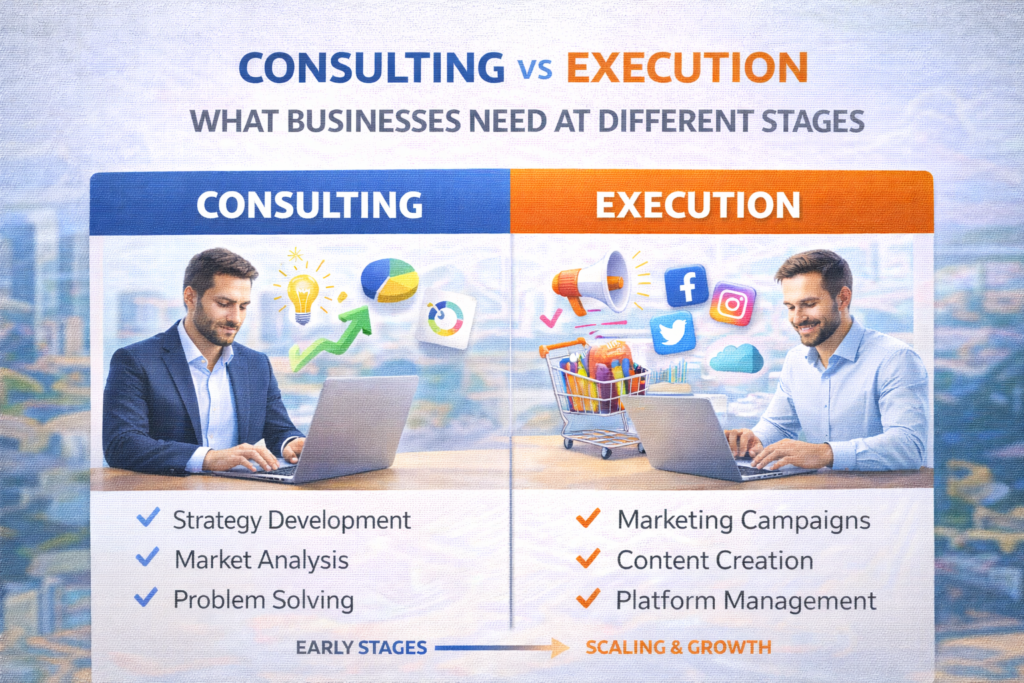
This blog explains the difference between consulting and execution and how each supports businesses at different growth stages. It helps decision makers choose the right approach to reduce wasted spend and build sustainable, scalable marketing systems.
Introduction
As businesses grow, their marketing needs evolve. What works at an early stage often becomes a limitation later. One of the most common questions I encounter is whether a business needs consulting or execution support. The answer depends entirely on the stage of growth, internal capabilities, and long term goals.
Understanding consulting vs execution helps businesses invest wisely, avoid wasted budgets, and build sustainable growth systems. Each plays a distinct role, and choosing the right one at the right time can accelerate progress dramatically.
1. Understanding Consulting and Execution Clearly
Before comparing stages, it is important to define both concepts clearly.
What Consulting Means
Consulting focuses on strategy, diagnosis, and direction. A consultant analyzes the business, identifies bottlenecks, and builds a roadmap for growth. The role is advisory, not operational.
Consulting typically includes:
• Market and audience analysis
• Channel and funnel strategy
• Growth planning and prioritization
• System and process design
• Performance audits and insights
A consultant answers the question of what should be done and why.
What Execution Means
Execution focuses on implementation. This includes creating campaigns, managing platforms, publishing content, and optimizing performance on a day to day basis.
Execution typically includes:
• Running ads and managing budgets
• Publishing content and social posts
• Managing SEO and paid media
• Email campaigns and automation
• Reporting and optimization
Execution answers the question of how things get done consistently.
2. Early Stage Businesses Need More Execution Than Consulting
In the early stages, businesses usually need traction. The priority is visibility, leads, and feedback from the market.
At this stage, consulting vs execution leans heavily toward execution.
Why Execution Matters Early
Early stage businesses often have:
• Limited brand awareness
• Small budgets
• Few internal systems
• A need to test channels quickly
Execution helps validate ideas and generate real world data. Without action, there is nothing to analyze.
According to data shared by CB Insights, many startups fail due to lack of market demand. Execution helps uncover demand faster.
Common Execution Needs at This Stage
• Basic website and landing pages
• Initial SEO and content publishing
• Paid ads testing
• Social media presence
• Simple email follow ups
Tools such as Google Analytics and Google Ads are often enough to support early execution.
Consulting can still help, but it should be lightweight and focused on guidance rather than deep strategic frameworks.
3. Growing Businesses Need Consulting to Reduce Chaos
As traction builds, complexity increases. More channels, more data, and more decisions start to overwhelm teams.
This is where consulting vs execution begins to shift.
Signs a Business Needs Consulting
• Marketing efforts feel scattered
• Results are inconsistent
• Costs are rising without clear ROI
• Teams are busy but growth is slow
• Decisions rely on opinions instead of data
Consulting helps bring structure and clarity.
Research from McKinsey shows that businesses with clear growth strategies outperform peers in revenue growth.
What Consulting Delivers at This Stage
• Channel prioritization
• Funnel optimization strategy
• Messaging and positioning clarity
• Budget allocation guidance
• Measurement frameworks
Tools like Semrush and Ahrefs support data driven insights during this phase.
Execution still matters, but without strategic alignment, it often leads to diminishing returns.
4. Scaling Businesses Need Strategy Before More Execution
Scaling is where mistakes become expensive. At this stage, doing more is not the answer. Doing the right things consistently is.
Consulting vs execution becomes more balanced, with consulting often leading.
Why Consulting Is Critical at Scale
Scaling businesses face challenges such as:
• Team expansion
• Channel saturation
• Rising acquisition costs
• Complex customer journeys
• Cross department alignment
A consultant helps design systems that scale rather than patching problems.
According to Gartner, organizations that align marketing strategy with business objectives achieve stronger performance outcomes.
Strategic Focus Areas
• Growth model refinement
• Conversion optimization strategy
• Customer lifetime value analysis
• Automation and CRM alignment
• Long term content and SEO planning
Platforms like HubSpot and Salesforce often become central during this phase.
Execution teams then operate within a clear framework rather than reacting to short term pressures.
5. Mature Businesses Need Consulting to Stay Relevant
Even established businesses cannot rely on past success forever. Markets change, competitors evolve, and customer behavior shifts.
At this stage, consulting vs execution heavily favors consulting for transformation and innovation.
Challenges Mature Businesses Face
• Legacy systems
• Declining growth rates
• Internal silos
• Resistance to change
• Inefficient processes
Consulting helps challenge assumptions and guide change.
Insights from Forbes highlight that businesses that invest in strategic advisory adapt faster to market shifts.
Consulting Impact at Maturity
• Business model evaluation
• Market repositioning
• Digital transformation planning
• Advanced analytics adoption
• Innovation roadmaps
Execution teams still play a role, but without strategic direction, effort often maintains the status quo rather than driving growth.
6. Why Many Businesses Choose the Wrong Approach
A common mistake is choosing execution when consulting is needed, or vice versa.
Execution Without Consulting Leads To
• Wasted budgets
• Short term wins without sustainability
• Conflicting tactics
• Team burnout
Consulting Without Execution Leads To
• Plans that never launch
• Delayed results
• Missed opportunities
The most effective growth happens when both work together.
7. Combining Consulting and Execution Effectively
The most successful businesses integrate consulting and execution rather than treating them as separate decisions.
An effective model looks like this:
• Consulting defines strategy and priorities
• Execution implements within clear boundaries
• Data informs continuous improvement
• Regular reviews adjust direction
Tools such as Google Looker Studio help connect strategy with performance visibility.
According to Harvard Business Review, organizations that align strategy and execution are more likely to achieve sustained growth.
8. How To Decide What Your Business Needs Right Now
To determine whether consulting or execution is the priority, consider these questions:
• Do you know exactly which channels drive growth
• Is your marketing predictable or reactive
• Are teams aligned around clear goals
• Can you explain why performance changes happen
If clarity is missing, consulting should come first.
If clarity exists but action is lacking, execution is the priority.
Final Thoughts
Understanding consulting vs execution is not about choosing one forever. It is about choosing the right support at the right stage. Early businesses need action. Growing businesses need clarity. Scaling businesses need systems. Mature businesses need reinvention.
When consulting and execution work together, businesses move from guessing to growing with confidence.
For more insights on building scalable marketing systems and choosing the right growth approach, visit alijaffarzia.com.
FAQs
1. What is the main difference between consulting and execution
Consulting focuses on strategy and direction while execution focuses on implementation.
2. Can a business need both consulting and execution
Yes. Most growing businesses benefit from a combination of both.
3. When should a business prioritize consulting
When growth feels unclear, inconsistent, or inefficient.
4. Is execution enough for long term growth
Execution alone rarely supports long term scalability without strategy.
5. How often should businesses revisit consulting support
Regular strategic reviews help ensure alignment as markets and goals evolve.